Anecdotal Fallacy: When One Story Replaces Real Evidence
Spot the Fallacy Team
Team Content
Learn what the anecdotal fallacy is, see a real-life example, and understand why one personal story isn’t the same as real evidence.
 You’ve probably heard this argument before.
Someone makes a claim, and instead of showing data or studies, they say:
“Well, it worked for me.”
Or:
“My friend tried it and it was amazing.”
It sounds convincing. It feels personal. It feels real.
But this is one of the most common fallacies of reasoning in everyday arguments and fallacies: the anecdotal fallacy.
What Is the Anecdotal Fallacy?
The anecdotal fallacy is a logical fallacy where someone treats a personal story or single example as proof, instead of relying on broader, reliable evidence.
In simple terms: One experience is used to stand in for real data.
If you’re working through all logical fallacies, this one shows up constantly in health advice, product reviews, investing tips, and life advice in general.
A Simple, Real-Life Example
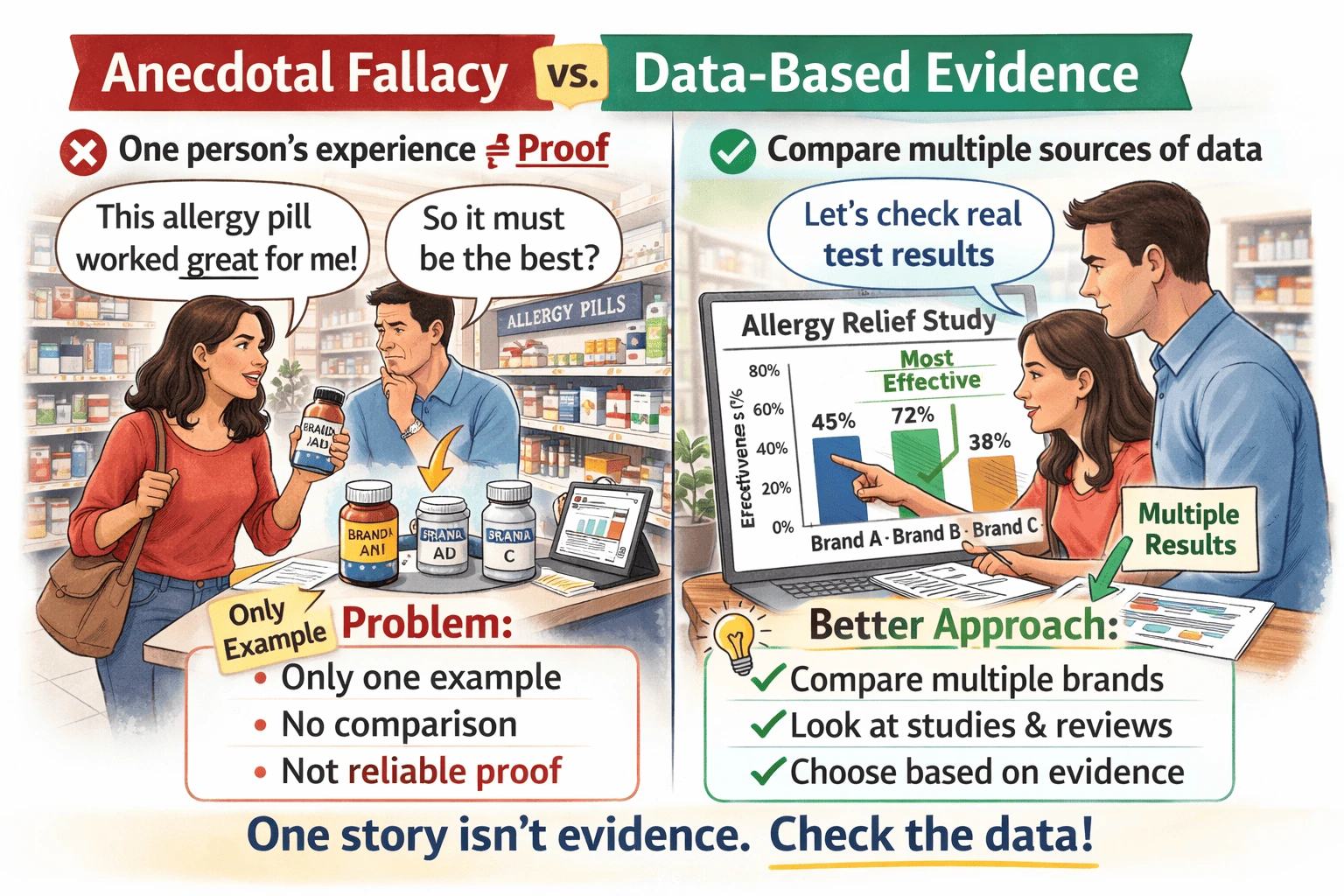
Maya and Daniel are standing in a pharmacy, trying to choose an allergy medicine.
Maya picks up one box and says:
“This one is amazing. I used it last year and it worked great for me.”
That sounds reassuring. It’s a real experience. It’s honest.
Daniel looks at the shelf—there are several brands. He pauses and says:
“Okay, but that’s just one experience. Let’s check how these compare overall.”
They look up a comparison chart and a study that tested the medicines across many people. The results show that another brand works better for most users.
Maya’s story wasn’t useless—but it wasn’t proof either.
Choosing based only on “it worked for me” would mean treating one story as enough evidence.
That’s the anecdotal fallacy.
Why Our Brain Loves Stories
Because stories are easy to remember.
They’re emotional. They feel concrete. They feel more “real” than charts or statistics. Our brains naturally trust:
- Personal experiences
- Vivid examples
- Stories from people we know
That’s why the anecdotal fallacy often shows up alongside other argument fallacies like the appeal to authority fallacy (“a famous person said it”) or the bandwagon fallacy (“everyone I know says it works”).
Different shortcuts. Same mistake: replacing evidence with something that just feels convincing.
Everyday Anecdotal Fallacy Examples
You’ll hear this kind of reasoning all the time:
“My uncle smoked his whole life and lived to 90, so smoking isn’t that bad.” “This app didn’t work for me, so it’s probably useless.” “My friend invested in this and lost money, so it’s a bad idea.” “I tried this diet once and hated it, so it doesn’t work.”
In each case, a single story is being used to judge a much bigger question.
That’s the anecdotal fallacy.
Why It’s a Problem
Stories can be useful. They can highlight possibilities. They can point you toward questions.
But they can’t replace evidence.
The anecdotal fallacy:
- Ignores larger patterns and data
- Overweights unusual or emotional cases
- Makes bad ideas look good (and good ideas look bad)
- Turns “this happened to me” into “this is how it always is”
Just like with hasty generalization or other logic and logical fallacies, the issue isn’t the story—it’s treating the story like proof.
How to Spot (and Avoid) It
When you hear:
“It worked for me…” “It didn’t work for my friend…” “I know someone who tried this…”
Pause and ask:
“Okay—but what does the broader evidence say?”
Personal experiences can start a conversation. They shouldn’t end it.
A good rule: Stories suggest. Evidence decides.
The Takeaway
The anecdotal fallacy happens when we replace data with a single story.
Stories are powerful. They’re memorable. They’re human.
But if you want better decisions—and better arguments across all logical fallacies—you have to ask for more than just one experience.
Don’t ask only, “Who did this work for?” Ask, “What happens for most people?”