
Ad Hominem Fallacy: Stop Attacking People, Start Answering Arguments
Spot the Fallacy Team
Team Content
Learn what the ad hominem fallacy is, see real-life examples, and understand why attacking a person instead of the argument leads to weak reasoning.
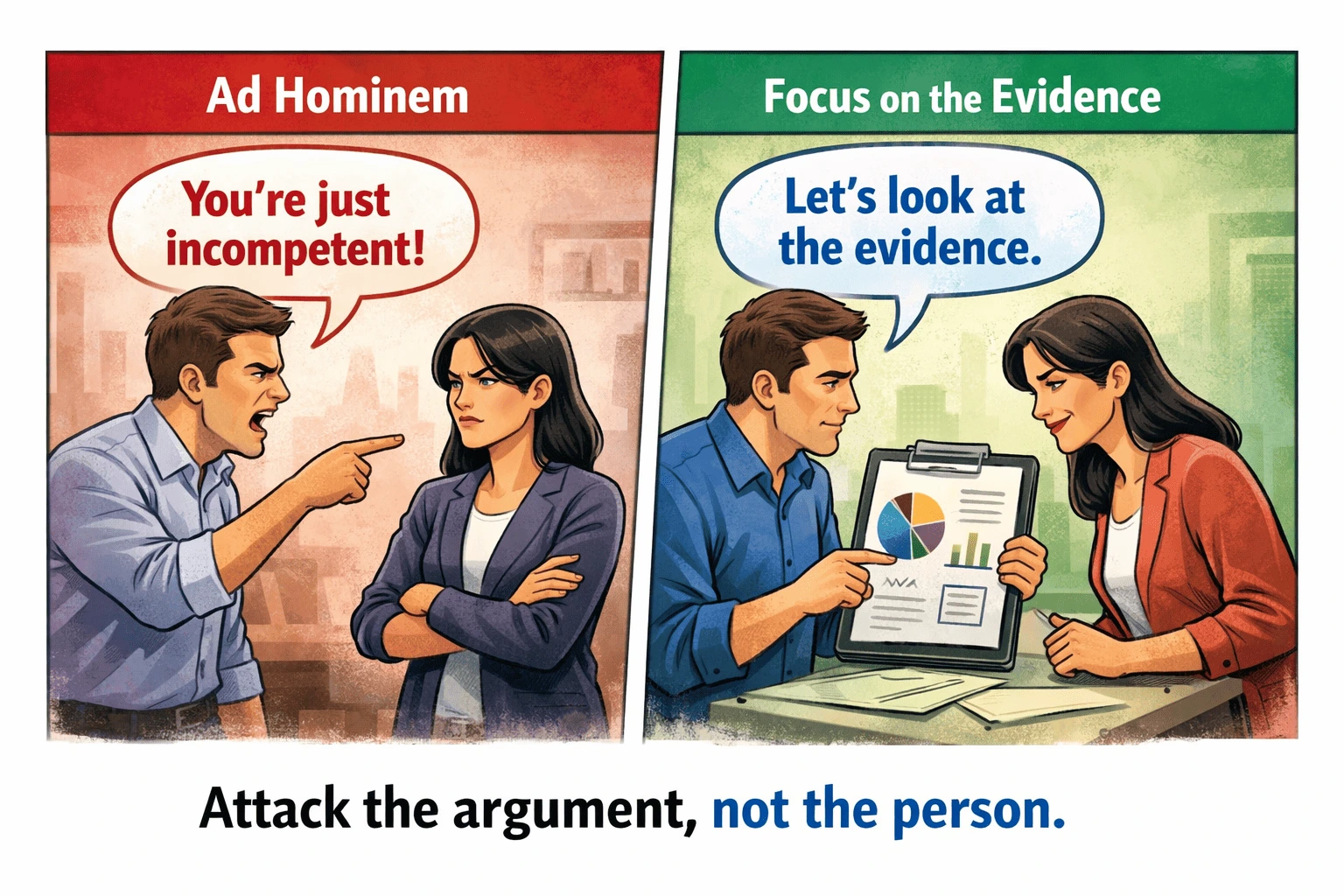 You’ve seen this happen. You’ve probably done it too.
Two people are arguing about something—work, politics, a product, a plan. One of them makes a point. The other doesn’t really answer it. Instead, they say something like:
“Why should we listen to you? You don’t even know how this works.”
And just like that, the conversation quietly changes direction.
This is one of the most common fallacies of reasoning you’ll see in everyday arguments and fallacies—the ad hominem fallacy.
What Is the Ad Hominem Fallacy?
The ad hominem fallacy is a logical fallacy where someone attacks the person making a claim instead of responding to the argument or evidence.
In simple terms, it replaces:
“Your idea is wrong because…” with “You’re wrong because you’re…”
If you’re exploring all logical fallacies, ad hominem is usually one of the first patterns people learn to spot—because it shows up almost everywhere, from office meetings to online comment sections.
A Simple, Real-Life Story
Mark and Julia are in a team meeting discussing a new feature.
Mark says the timeline is too aggressive and suggests delaying the release by two weeks to avoid bugs.
Instead of addressing the risk, someone says:
“Of course you’d say that. You always overthink things and slow everyone down.”
The room goes quiet. The topic changes.
No one checks whether the timeline is actually risky. No one looks at the data. The focus has shifted from the plan to the person.
That’s ad hominem in action.
Mark might be right or wrong—but his argument was never really answered.
Why Our Brain Uses This Shortcut
Because it’s easier.
Attacking a person feels quicker than dealing with evidence. It feels more emotional. It often gets laughs, likes, or support. And it lets you “win” without actually thinking very hard.
That’s why ad hominem shows up so often alongside other argument fallacies like the straw man fallacy (misrepresenting someone’s position) or red herring arguments (changing the subject to avoid the real issue).
Another close cousin is tu quoque, where someone dismisses a claim by accusing the speaker of hypocrisy instead of engaging with the point.
All of these moves avoid the same thing: the actual argument.
Everyday Ad Hominem Examples
You’ll hear this kind of faulty reasoning everywhere:
“You can’t trust her opinion on fitness, she’s overweight.” “He’s not even a graduate, why listen to his view on this?” “Your argument about budgeting is pointless—you’re bad with money anyway.” “Of course you think that, you’re just doing it for attention.”
Notice what’s missing in all of these.
No one is responding to the claim. They’re only attacking the person who made it.
That’s why ad hominem is such a persistent problem in logic and fallacy discussions and in real-life debates.
Why Ad Hominem Is a Problem
Ad hominem doesn’t just make arguments worse. It:
- Derails real discussion
- Protects weak positions from criticism
- Turns disagreements into personal fights
- Rewards confidence over correctness
A bad argument doesn’t become good because the speaker is flawed. And a good argument doesn’t become bad because the speaker is annoying.
This is why learning to spot ad hominem is a core part of understanding logic and logical fallacies.
How to Spot (and Stop) It
Next time you’re in a debate—online or offline—ask yourself:
Are we talking about the idea, or about the person? Would this response make sense if someone else had said the same thing? Did anyone actually answer the original point?
If the discussion shifts from “Is this true?” to “What’s wrong with you?”, you’re probably looking at ad hominem.
A simple way to respond is:
“Let’s talk about the argument, not the person.”
The Takeaway
The ad hominem fallacy happens when we attack the speaker instead of the statement.
It feels powerful. It feels personal. It feels like winning.
But it’s really just a way of avoiding the harder work of thinking.
If you’re serious about understanding all logical fallacies and improving how you handle arguments and fallacies in daily life, this is one of the first patterns worth mastering.