Straw Man Fallacy: Arguing Against a Weaker Version of the Real Point
Spot the Fallacy Team
Team Content
Learn what the straw man fallacy is, see simple real-life examples, and understand how misrepresenting an argument makes weak reasoning look strong.
 You’ve probably been in this conversation.
You say something careful. Reasonable. Maybe even boring.
And the other person responds to… something you didn’t actually say.
Suddenly, you’re defending a position you never took.
That’s the straw man fallacy at work.
It’s one of the most common fallacies of reasoning in everyday arguments and fallacies, especially online and in heated discussions.
What Is the Straw Man Fallacy?
The straw man fallacy is a logical fallacy where someone misrepresents your argument—making it simpler, more extreme, or easier to attack—and then argues against that weaker version instead of your real point.
In short: They don’t fight your argument. They fight a fake, easier version of it.
If you’re exploring all logical fallacies, this one shows up constantly because it’s an easy way to “win” without doing the harder work of understanding what the other person actually meant.
A Simple, Real-Life Story
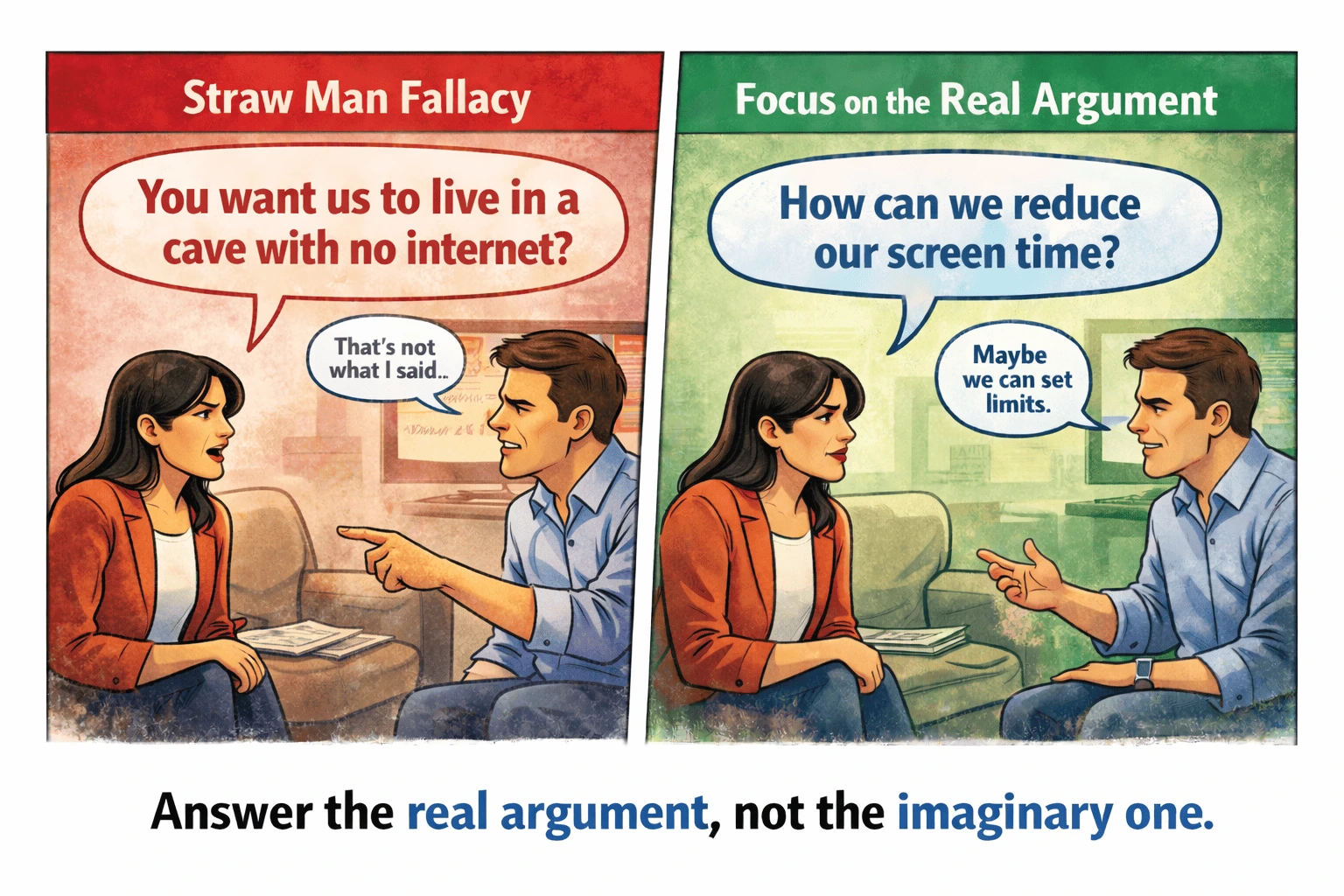
Emma and Leo are talking at home about how much time they spend on their phones.
Emma says:
“I think we’re spending a bit too much time on screens. Maybe we should try to reduce it a little.”
Leo immediately responds:
“So you want us to live in a cave with no internet and no technology at all?”
Emma looks frustrated.
“That’s not what I said. I just meant we could set some limits.”
See what happened?
Emma suggested a small, reasonable change: reducing screen time a bit. Leo turned it into an extreme position: giving up the internet entirely.
Now the discussion isn’t about setting healthy limits anymore. It’s about defending against a position Emma never took.
That’s the straw man fallacy: Replacing someone’s real argument with a more extreme, easier-to-attack version—and then arguing against that instead.
Why People Use This Trick
Because it makes arguments easier.
It’s much simpler to attack:
- An extreme version of someone’s view
- A simplified version of their point
- A version that sounds unreasonable or silly
This move also shows up alongside other argument fallacies like ad hominem (attacking the person) or red herring (changing the subject). All of them avoid dealing with the real argument.
Everyday Straw Man Examples
You’ll hear this kind of thing everywhere:
“I think we should reduce sugar in school lunches.” → “So you want to ban all tasty food?”
“We should add some rules to this process.” → “Wow, you want to control everything.”
“I’m not convinced this is the best approach.” → “So you think we should do nothing at all?”
In each case, a moderate, specific point gets turned into an extreme, easier-to-attack version.
That’s the straw man fallacy.
Why It’s a Problem
Straw man arguments:
- Waste time arguing about things no one actually said
- Make real discussions impossible
- Create unnecessary conflict
- Reward exaggeration over understanding
- And make bad ideas survive by dodging real criticism
Like ad hominem, it feels like winning. But it’s really just arguing with a made-up version of someone’s view.
How to Spot (and Respond to) a Straw Man
Watch for phrases like:
“So you’re saying…” “What you really mean is…” “Basically, you want to…”
Then check:
Did they actually repeat your point fairly? Or did they make it more extreme or simpler than what you said?
A calm response often works best:
“That’s not what I said. My actual point is…”
And then restate it clearly.
The Takeaway
The straw man fallacy happens when someone replaces your real argument with a weaker one—and then attacks that instead.
If you care about understanding logic and logical fallacies, this is one of the most important patterns to recognize, because it shows up everywhere from meetings to social media to politics.
Good arguments deal with what people actually say. Not with easier, imaginary versions of it.