Appeal to Authority Fallacy: When “Who Said It” Replaces Real Evidence
Spot the Fallacy Team
Team Content
Learn what the appeal to authority fallacy is, see a simple real-life example, and understand why a claim needs evidence, not just a famous name.
 You’ve heard this argument before.
Someone makes a claim. There isn’t much evidence. But then they add:
“A famous expert said this, so it must be true.”
And suddenly, the conversation feels… over.
No one asks why it’s true. No one checks what the evidence is. The name does all the work.
That’s one of the most common fallacies of reasoning in everyday arguments and fallacies: the appeal to authority fallacy.
What Is the Appeal to Authority Fallacy?
The appeal to authority fallacy is a logical fallacy where a claim is treated as true just because an authority figure says it, rather than because there’s solid evidence to support it.
In simple terms: “Trust this, because someone important said so.”
If you’re working through all logical fallacies, this one shows up constantly—in ads, social media, politics, health advice, and even at work.
A Simple, Real-Life Story
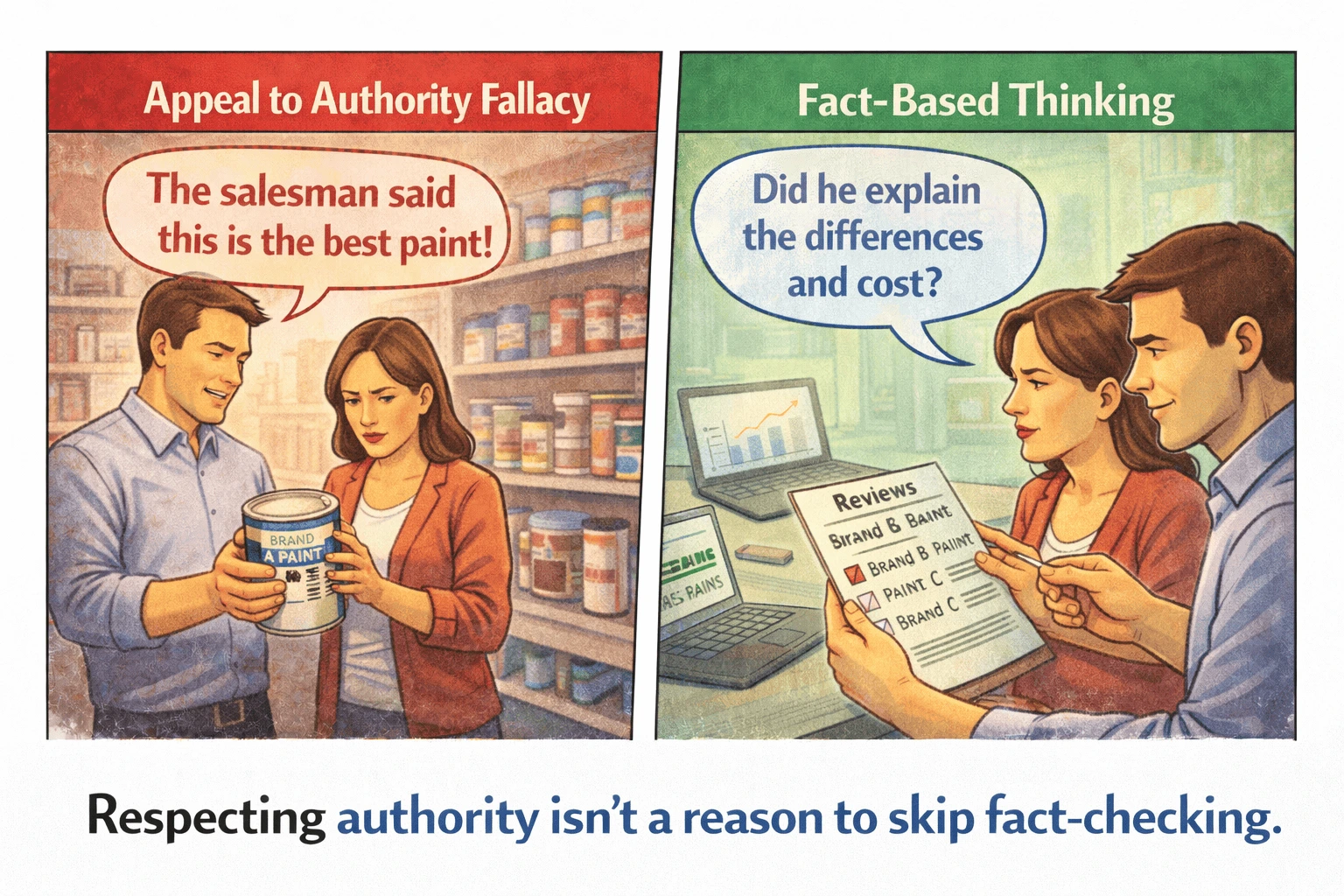
Emma and Leo are at a hardware store, trying to choose paint for their living room.
They’re standing in front of a shelf full of options when a salesman walks over, picks up one can, and says:
“This is the best paint we have. Everyone buys this one.”
Leo looks relieved and says:
“Great, let’s just take this.”
Emma hesitates.
“Did he explain why it’s better? Or how it compares to the others?”
They start looking at reviews, checking durability, finish, and price. A few minutes later, they realize another brand actually fits their needs better—and costs less.
The first choice felt convincing because the salesman said so. The better choice came from looking at the reasons and the evidence.
That first impulse—trusting the claim just because an authority figure said it—is the appeal to authority fallacy.
Why Our Brain Falls for It
Because trusting experts usually makes sense.
In real life, we should listen to doctors, engineers, scientists, and experienced professionals. The shortcut saves time and reduces risk.
But the shortcut turns into a fallacy when:
- The “authority” isn’t actually an expert in that field
- Or the authority’s opinion is treated as proof, not as one input
- Or the evidence is never checked at all
That’s why this fallacy often shows up next to other argument fallacies like the bandwagon fallacy (“everyone believes this”) or even ad hominem (“don’t listen to him, listen to her instead”).
Different tricks. Same result: less thinking, more following.
Everyday Appeal to Authority Examples
You’ll hear this kind of reasoning everywhere:
“A celebrity says this product works, so it must be good.” “A famous entrepreneur believes this, so it has to be right.” “This expert said it on TV, so the debate is settled.” “Who are you to disagree? They’re a professor.”
In each case, the person is doing the work that evidence should be doing.
That’s the appeal to authority fallacy.
Why It’s a Problem
Appeal to authority doesn’t mean the claim is false. It means the reason given for believing it is weak.
Relying on it:
- Lets bad ideas hide behind big names
- Makes people stop asking for evidence
- Confuses “someone important believes this” with “this is true”
- And turns discussions into status contests instead of evidence checks
Just like in many logic and logical fallacies, the issue isn’t who is speaking—it’s whether the reasons hold up.
How to Spot (and Avoid) It
When you hear:
“An expert said this…” “A famous person believes this…” “This authority agrees with me…”
Ask one simple question:
“Okay—but what’s the evidence?”
Good authorities can point you toward good reasons. They can’t replace good reasons.
A strong argument should still make sense even if you don’t know who said it.
The Takeaway
The appeal to authority fallacy happens when we swap evidence for reputation.
Experts matter. Experience matters. Credentials matter.
But in good reasoning—across all logical fallacies and good arguments—evidence still comes first.
Don’t ask, “Who said this?” Ask, “Why should this be true?”