
Bandwagon Fallacy: When Popularity Feels Like Proof
Spot the Fallacy Team
Team Content
Learn what the bandwagon fallacy is, see simple real-life examples, and understand why popularity is not the same as proof or evidence.
 You’ve seen this argument everywhere.
A product goes viral. A post gets millions of likes. Everyone around you seems to agree with one opinion.
And someone says:
“Well, if everyone thinks this, it must be true.”
It sounds reasonable. It feels safe. It feels… obvious.
But this is one of the most common fallacies of reasoning in everyday arguments and fallacies: the bandwagon fallacy.
What Is the Bandwagon Fallacy?
The bandwagon fallacy is a logical fallacy where a claim is treated as true just because many people believe it.
In simple terms: If it’s popular, it must be right.
If you’re exploring all logical fallacies, this one shows up constantly—especially in marketing, politics, social media, and group decisions at work.
A Simple, Real-Life Story
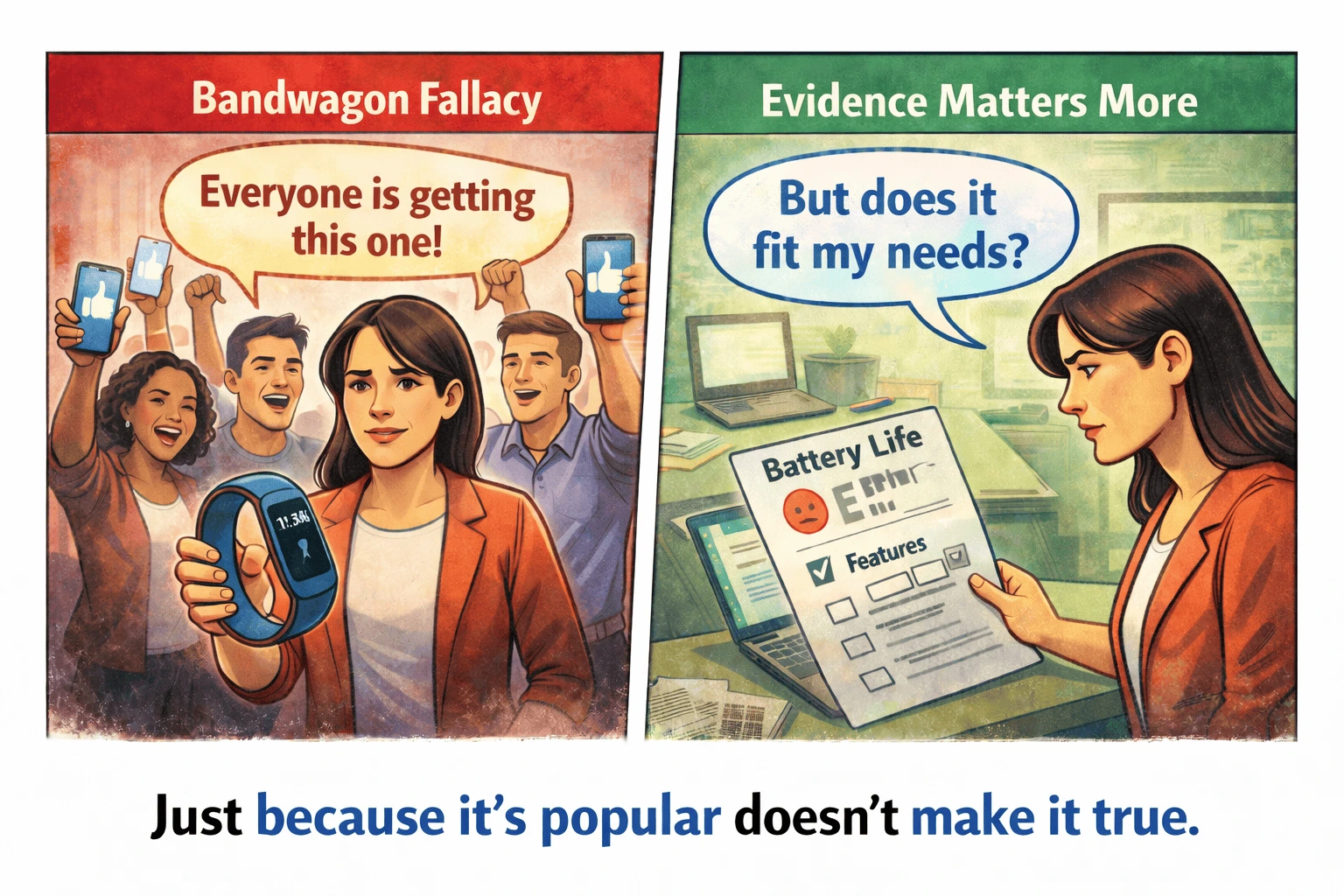
Sara is thinking about buying a new fitness tracker. She’s not sure which one to choose, so she checks reviews and social media.
One model keeps popping up everywhere. Influencers are using it. Her friends are talking about it. It’s all over her feed.
At lunch, someone says:
“Everyone is buying this one. It has to be the best.”
Sara feels the pressure. If everyone likes it, choosing something else feels risky. So she buys it—without really checking whether it fits her needs.
A week later, she realizes the battery life is terrible for her usage and half the features don’t matter to her.
The product wasn’t good or bad because it was popular. But popularity is what made the decision feel “obvious.”
That’s the bandwagon fallacy in action.
Why Our Brain Falls for It
Because being with the crowd feels safe.
Agreeing with many people:
- Reduces the fear of being wrong
- Saves time on thinking and comparing
- Feels socially comfortable
- Feels like a shortcut to the “right” answer
This is why the bandwagon fallacy often appears alongside other argument fallacies like appeal to authority (“experts say so”) or even ad hominem (“only idiots disagree”). Different tricks, same result: less thinking, more following.
Everyday Bandwagon Fallacy Examples
You’ll hear this kind of reasoning everywhere:
“Everyone is switching to this app, so it must be better.” “This opinion has millions of likes, so it’s clearly right.” “All successful companies do this, so we should too.” “Nobody I know disagrees, so there’s probably no real problem with it.”
In each case, popularity replaces evidence.
That’s the bandwagon fallacy.
Why It’s a Problem
Popularity tells you what’s common. It doesn’t tell you what’s true, useful, or right for your situation.
The bandwagon fallacy:
- Rewards trends over thinking
- Makes bad ideas spread faster
- Pressures people into lazy agreement
- And turns “many people believe this” into “this must be correct”
History is full of popular ideas that turned out to be wrong. Popularity is not proof—just like in many other logic and logical fallacies.
How to Spot (and Avoid) It
When you hear:
“Everyone thinks this…” “Most people agree…” “It’s trending, so…”
Pause and ask:
“Okay—but what’s the actual evidence?”
A good decision or argument should still make sense even if fewer people believed it.
The Takeaway
The bandwagon fallacy happens when we confuse popularity with truth.
Lots of people believing something can tell you it’s common. It can’t tell you it’s correct.
If you’re learning to navigate all logical fallacies and improve how you handle arguments and fallacies in daily life, this is one of the most important habits to build:
Don’t ask, “How many people believe this?” Ask, “Why should I believe this?”