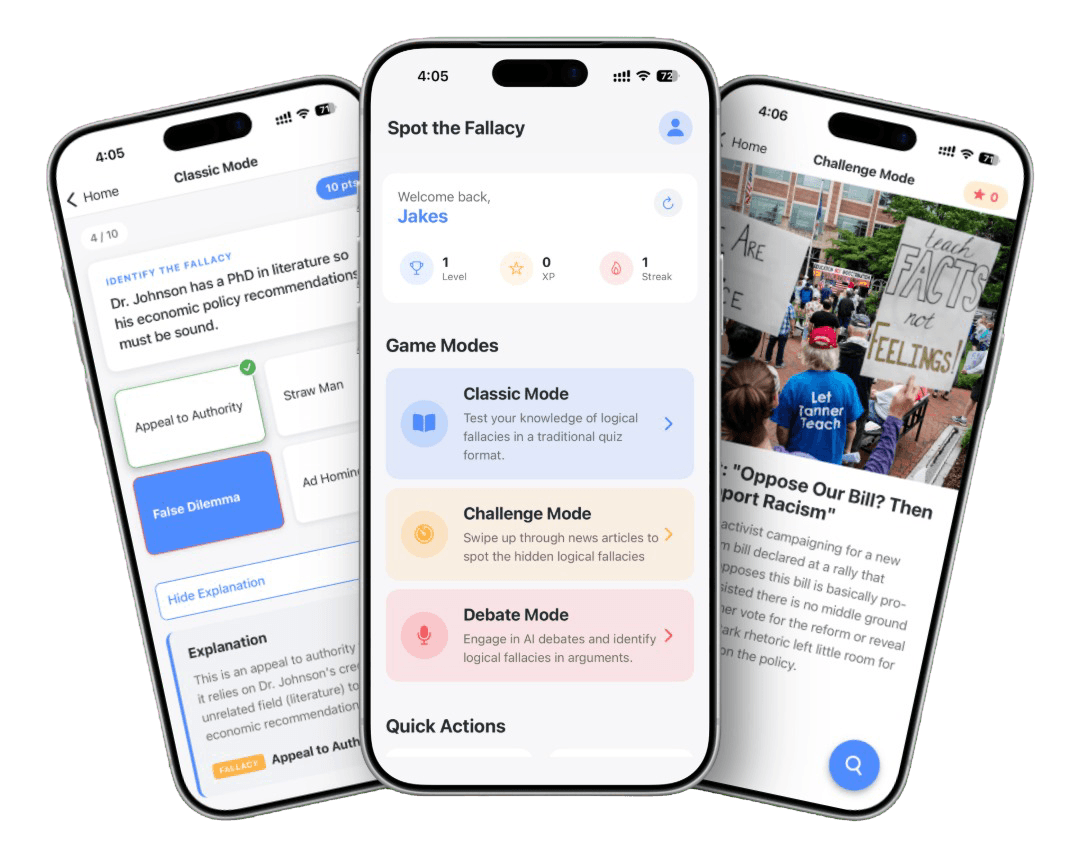
False Dilemma Fallacy
Spot the Fallacy Team
Team Content
A false dilemma fallacy presents only two options when more possibilities exist, forcing an unnecessary choice.
A false dilemma fallacy presents only two options when more possibilities exist. It forces a choice between extremes and ignores nuance.
TLDR
- What it is: A false dilemma fallacy presents only two options when more possibilities exist.
- How to spot it: The argument says "either" or "only" without evidence.
- Example: Either you support my plan, or you do not care about results.
- How to respond: Ask, "What other options are possible?"
Why is it a fallacy?
Real-world problems rarely have only two answers. By hiding alternatives, the argument makes a weak option look inevitable or a strong option look reckless.
The core problem is a broken link between the premise and the conclusion. Even if the premise is true, it does not establish the claim being made. A valid argument needs a clear chain from evidence to conclusion, and this pattern skips that chain.
Why does it feel persuasive?
- It creates clarity when people feel uncertain.
- It makes the speaker sound decisive.
- It pressures the listener to choose a side.
It feels persuasive because it reduces uncertainty and offers a simple story. When people are busy or emotionally invested, that simplicity can feel like strong evidence even when it is not.
How do you spot it?
- The argument says "either" or "only" without evidence.
- The options are extreme opposites.
- You can easily name a third option.
A quick test is to restate the argument as 'Because X, therefore Y.' If X does not actually justify Y, the reasoning is weak. Another signal is when the argument leans on labels, emotion, or reputation instead of evidence.
Quick check questions:
- What exactly is the claim?
- What evidence is offered?
- Would the claim still stand if I removed the label or emotion?
What are examples of False Dilemma Fallacy?
- Either you support my plan, or you do not care about results.
- If you are not with us, you are against us.
- We either cut costs now or the company fails.
In real life, this pattern shows up in marketing, politics, and everyday debates. The examples below illustrate the leap from a premise to a conclusion without the missing evidence.
How should you respond?
- Ask, "What other options are possible?"
- Offer a third alternative or a spectrum.
- Reframe the problem into smaller choices.
You do not need to accuse anyone of a fallacy. Focus on the missing link and ask for evidence that actually supports the conclusion. If the tone is heated, use neutral language and restate the claim in a calmer form.
Helpful response lines:
- What evidence would make that conclusion true?
- Can we separate the claim from the person?
- What would change your mind here?
What fallacies are often confused with False Dilemma Fallacy?
These fallacies can look similar because they all weaken the evidence chain. The difference is the specific move being made, so compare definitions to see which pattern fits best.
Where does False Dilemma Fallacy show up in real life?
You will see this pattern in debates, marketing, workplace decisions, and social media. It often appears when someone wants a quick win or when the stakes feel personal. The more emotional the situation, the more likely this shortcut appears.
What questions help you test for False Dilemma Fallacy?
Use questions that force the reasoning into the open before you accept the conclusion.
Try these checks:
- What evidence would make this conclusion true?
- Is the evidence relevant and sufficient, or just persuasive?
- What alternative explanation could also fit the facts?
How can you avoid using False Dilemma Fallacy yourself?
Most people use fallacies by accident. The fix is to slow down and check your own reasoning before you speak.
A simple self-check:
- State your claim in one sentence.
- List the evidence you would accept as support.
- Ask whether that evidence actually proves the claim.
What does a real-world False Dilemma Fallacy argument look like?
Most real examples are short and confident, which is why the mistake slips by. The structure looks reasonable until you slow it down and check the evidence link.
Break it down like this:
- Claim: The conclusion is presented as certain.
- Reason: A single factor is treated as enough proof.
- Missing link: The evidence that actually connects the factor to the conclusion.
How can you practice spotting False Dilemma Fallacy this week?
Practice is about pattern recognition, not memorizing labels. A few minutes of focused attention each day builds the habit.
Try this simple routine:
- Find one example in news, ads, or social media.
- Write the claim and the offered reason in one sentence.
- Ask what evidence would actually make the claim true.
Why does False Dilemma matter outside debates?
This fallacy does more than weaken arguments. It can influence hiring, purchasing, policy decisions, and relationships because it makes a weak conclusion feel justified. When the reasoning is wrong, the decision can be wrong even if the speaker sounds confident.
In fast-moving situations, people default to shortcuts. Recognizing the pattern helps you slow down and ask for real evidence before you accept the conclusion.
What is a quick checklist for False Dilemma?
Use this quick checklist to test whether the reasoning is valid before you accept it.
- What is the exact claim?
- What evidence is offered?
- Is the evidence relevant and sufficient, or just persuasive?
- What key link between reason and conclusion is missing?
- Would the claim still stand if you removed labels or emotion?
What is a real-world False Dilemma scenario?
Scenario: A speaker argues that presents only two options when more possibilities exist. It sounds decisive, but the conclusion still needs evidence that connects the reason to the claim. Without that link, the argument remains weak.
What misconceptions lead to False Dilemma?
A common misconception is that a confident tone or a familiar label counts as evidence. Another is that a single example can stand in for a general proof. These misconceptions make weak reasoning feel strong, especially when the conclusion fits what we already want to believe.
A good mental reset is to ask: if someone with the opposite view used the same reasoning, would it still feel convincing?
How can you break down False Dilemma step by step?
Use a simple breakdown to separate claim, evidence, and missing link. This makes the weak step visible and helps you respond without getting stuck in tone or emotion.
- Claim: the conclusion being asserted.
- Evidence: the reasons offered.
- Missing link: the evidence that would actually make the claim true.
- Correction: what kind of evidence would close the gap?
How do you explain False Dilemma to someone skeptical?
Start by acknowledging the conclusion may be true in some cases, then point out that the reasoning does not prove it. People are more receptive when you separate the idea from the person and focus on the missing evidence.
A useful phrase is: "What you said might be right, but the reason you gave doesn’t prove it. What evidence would actually support the claim?"
FAQ
How do I identify False Dilemma Fallacy?
The argument says "either" or "only" without evidence.
Is False Dilemma Fallacy always a fallacy?
Only when the move replaces evidence or reasoning. If the point is directly relevant, it is not a fallacy.
How should I respond to False Dilemma Fallacy?
Ask, "What other options are possible?"
References
- Stanford Encyclopedia of Philosophy (Fallacies)
- Internet Encyclopedia of Philosophy (Logic and Critical Thinking)
- Nizkor Project (Fallacies)