
Hasty Generalization Fallacy: How One Bad Experience Turns Into a Bad Conclusion
Spot the Fallacy Team
Team Content
Learn what the hasty generalization fallacy is, see simple real-life examples, and understand how one bad experience can lead to faulty conclusions.
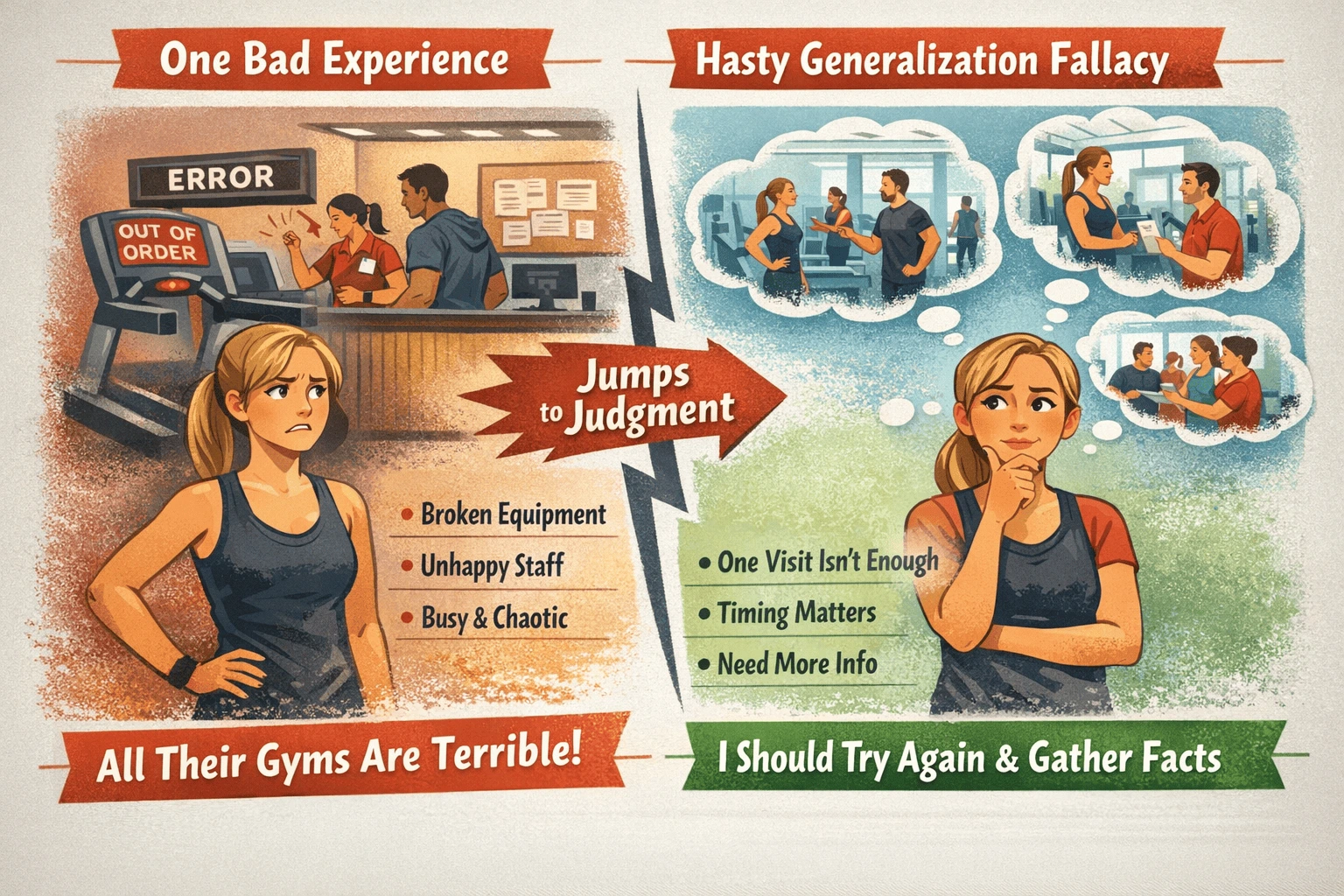
You’ve probably done this.
You try a new place, app, or service. It goes badly. Something breaks. The timing is off. You leave annoyed.
Later, you hear yourself say:
“That place is bad.”
Not that day was bad. Not my experience was bad. Just… that place is bad.
That’s the hasty generalization fallacy in action.
What Is the Hasty Generalization Fallacy?
The hasty generalization fallacy is a logical fallacy where someone draws a broad conclusion from a small or unrepresentative sample.
In simple terms: You see a little, and you conclude a lot.
A Simple, Real-Life Example
Emma wanted to change gyms. A friend suggested a popular chain that had just opened nearby.
She went after work on a busy day. The front desk was overwhelmed. A trainer looked distracted. One treadmill kept failing.
That night, she said:
“I’m not joining that chain. Their gyms are badly managed.”
A few weeks later, she heard coworkers say the same gym was smooth and well-run, especially in the mornings. The opening weeks, it turned out, had just been chaotic.
Emma hadn’t judged the gym. She had judged everything based on one visit.
Why Our Brain Does This
Your brain likes shortcuts. It wants quick rules like:
“Don’t go there.” “Don’t try that again.”
That feels efficient. But when the rule is built on one or two experiences, it’s usually weak evidence pretending to be a strong conclusion.
Everyday Hasty Generalization Examples
“This app crashed once. It’s unreliable.” “I met two rude people from there. People there are rude.” “My first attempt failed. This doesn’t work.”
Notice the jump: from one case to always.
Why It’s a Problem
Hasty generalization:
- Pushes you away from good options for weak reasons
- Turns temporary problems into permanent labels
- Makes you confident on very little evidence
It feels decisive. It often isn’t accurate.
How to Avoid It
When you catch yourself thinking:
“This always happens.” “They’re all like that.”
Ask one question:
“How much evidence do I actually have?”
If the answer is “not much,” you’re probably looking at hasty generalization, not a real pattern.
The Takeaway
The hasty generalization fallacy is what happens when we confuse a moment with a pattern.
Bad days happen. Timing matters. One experience is not the whole story.
Better thinking starts when you stop turning:
“This went badly once”
into:
“This is how it always is.”